


 Log In
Top 5 Friday | Best Techno VST Plugins
Top 5 Friday | Best Techno VST Plugins
5. FabFilter Pro-R
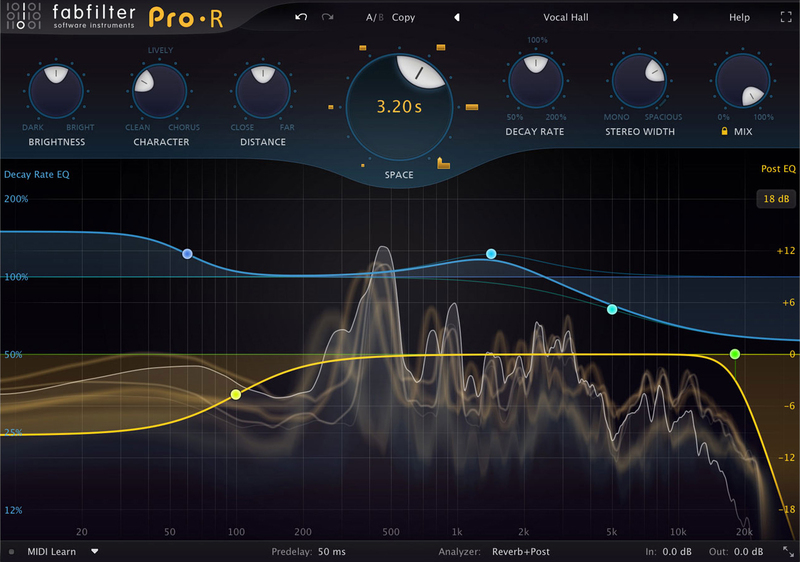
Perfect dystopian techno needs a perfect dystopian reverb, and FabFilter’s Pro-R is just that. Pro-R has all the hallmarks of any regular reverb plugin, with Space, Decay time and many more parameters, but it’s the lower half that makes it so versatile…
Here, the yellow curves act to EQ the reverb signal, and the blue curves change the decay time for different frequencies. This gives you a new way to emphasise or roll back different frequencies by changing their timing or their level.
Add to that the easy Brightness, Character, Distance and Width controls, as well as all your favourite reverb parameters, and you’ve got a workhorse reverb for any style.
4. Soundtoys Decapitator
If you’re mixing techno, you’re going to want some analogue distortion and saturation… and Decapitator gives you exactly that, in five flavours – A, E, N, T and P – based on different types of distorting hardware circuits including tape machine preamp, channel strip, mixing console, and two hardware distortion processors.
Just push up the Drive to get things moving, and for the fuzzy cherry on top, there’s the Punish button to bring things right to the brink. Elsewhere, Decapitator has Low Cut, High Cut and Tone controls to customise the distortion to your liking.
3. Audio Realism Bass Line 3
Roland’s TB-303 practically spawned techno, and we reckon that Audio Realism’s Bass Line 3 takes the biscuit in the world of 303 plugins. The idea behind ABL is to recreate the TB-303 as faithfully as possible, while also tacking on a few modern-day improvements and digital-world upgrades.
ABL3 nails the sound of the 303, and it adds in functions too, such as the Pattern Edit view, which lets you program notes for multiple parts at the same time, and includes loads of advanced tweaks for customising the VCO, the VCA, gate and accent response, and more.
This one also has a Wave Analyser which can automatically transcribe 303 patterns to be played in ABL – very cool.
2. D16 Group Drumazon
While the 303 provided the squelchy bass of techno’s birth, Roland’s TR-909 groovebox provided the beats, and often still does to this day. D16 Group’s Drumazon is a bang-on emulation of the 909, and also offers some improvements of its own for the virtual world.
As well as using Drumazon with the in-built step sequencer, as is hallowed techno tradition, you can control the plugin using MIDI, getting your own gate lengths using note sizes. Other enhancements for the computer-based version include more parameters to tweak for the individual drum sound modules, DAW tempo sync, intelligent rescale, and a randomizer.
1. Arturia Jup-8 V
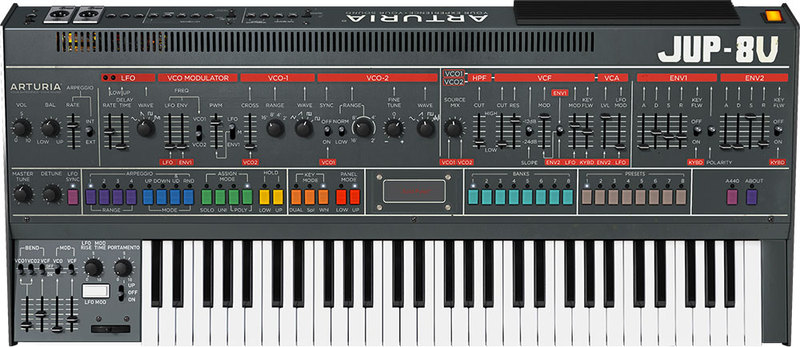
Roland’s Jupiter-8 is an 80s classic, a polyphonic synth that helped birth techno as a genre, but didn’t have any MIDI control onboard. But thanks to the wonders of plugin technology, you can integrate Arturia’s virtual version with the rest of your setup in your DAW.
Arturia have extended their Jupiter to 32-voice polyphony, included something called the Galaxy Module for advanced LFO patterns, and added keyboard splitting and layering.
If you’re looking for an authentic Jupiter-8 experience, but with none of the connectivity hassles or maintenance requirements – let alone the price tag – of the original unit, this is the one for you.
Other articles
The Best Music Software Deals This Week [Live List]
As the music production landscape evolves week by week, so does the opportunity to save on powerful creative tools. New plugin releases, flash sales on VSTs and limited-time deals on music software can appear from any angle, making it harder than ever to keep track of what’s worth your attention. Whether you're looking for the latest bundles on offer, or even deals on exciting virtual instruments, it's as important as ever to stay up to date on what we have to offer. That’s where our live g
ESEA Heritage Month: 5 Artists You Should Know About
Founded in September 2021 by besea.n (Britain's East and South East Asian Network), ESEA Heritage Month celebrates the culture, history, and contributions of East and Southeast Asian communities across the UK. To mark the month, we’ve partnered with ESEA Music, a UK-based, community-led non-profit founded in 2021 to empower ESEA artists and music professionals, to spotlight five incredible independent artists shaping the UK music landscape. Jeremine Chan Malaysian Chinese • Multi-Genre / E
Aaron Suiss Builds Self-Actualization From Diva’s INIT Patch
Presets are a normal part of modern production, and Aaron Suiss is pretty open about using them for some of the biggest layers in his latest release, “Self-Actualization,” which spent a week in the Hype Charts on Beatport. The bass and pad began with Plug Hugger presets inside u-he Diva. But the star of the show was the arpeggiator, which he created from INIT after the options he auditioned just didn’t bring the emotional depth and power the record needed. Created with Enzo Vood and released
Synth Month Sale: The Best Deals on Synth VSTs & Bundles
It’s September, and that only means one thing for all you producers out there – it’s Plugin Boutique’s Synth Month, the ultimate synth plugins sale! Across the month, you can buy synthesizers at massive discounts. Expect big savings on the best software synths, from characterful vintage synth emulations all the way through to cutting-edge modern sound machines. Not only that, but you’ll be able to pick up some deliciously discounted synth bundles that can’t be missed. To celebrate, we


