


 Log In
Free gifts available with your purchase
SMOOTH, WARM, WIDE, and PUSH. Resonance control, harmonic character, stereo width, three compression characters. one license key unlocks all four. Plus CHECK free.
SMOOTH
.gif)
Catch the resonances your EQ can't.
Dynamic suppression across 40 ERB bands mapped to how your ear resolves frequency. SMOOTH rides each band independently and only acts when a resonance flares.
What makes SMOOTH different.
01 / Psychoacoustic precision
- 40 frequency bands mapped to how you actually hear. Not arbitrary frequency splits.
02 / Dual character modes
- Resonance mode for sustained harshness. Transient mode for percussive spikes. Switch or blend.
03 / M/S routing
- Process mid and side independently. Tame center-panned vocals without touching the stereo field.
04 / Spectral display
- Real-time visualization of what's being reduced. See the problem, see the solution.
Features
- 4096-point FFT
- 40 ERB bands
- Under 3% CPU
- 32 factory presets
- 5 controls
- $29 forever
- VST3 / AU
- Zero-delay feedback filters
- M/S processing
WARM
.gif)
Tape, tube, transformer with per-harmonic control.
Tape for warmth, tube for even harmonics, transformer for asymmetric drive. Each harmonic shaped independently through 7th-order Chebyshev waveshaping. Not random distortion.
What makes WARM different.
01 / Three real characters
- Tape is warm and gritty. Tube adds rich even harmonics. Transformer goes deep with asymmetric character. They actually sound different.
02 / Precise harmonic control
- Each harmonic is controlled independently. Not random distortion. Precise harmonic architecture.
03 / Spectral-aware drive
- Per-band spectral pre-gain shapes the signal before saturation. The spectral display shows exactly what's happening.
04 / Program-dependent response
- An envelope follower modulates drive with input level. Louder signals push harder, like real analog circuits.
Features
- 3 saturation modes
- 7th-order Chebyshev
- under 3% CPU
- 34 factory presets
- 4 controls
- $29 forever
- VST3 / AU
- adaptive oversampling
- K-weighted auto-comp
WIDE

Stereo width that holds up in mono.
Allpass decorrelation across 40 ERB-warped bands, with per-band correlation feedback that keeps every frequency mono-safe. Expand without phase collapse. No Haas tricks.
What makes WARM different.
01 / Psychoacoustic width curve
- Width follows human perception of stereo across frequency. Most expansion where your ears are most sensitive. Based on perceptual research.
02 / Three stereo modes
- STEREO for natural width. M/S for mid-side balance. HAAS for delay-based widening. Each mode uses different psychoacoustic strategies.
03 / Mono-compatible by design
- Per-band correlation feedback keeps every frequency safe for mono. The MONO button lets you check instantly. No phase cancellation surprises.
04 / Frequency-focused expansion
- The FOCUS knob targets width to a specific frequency range. Expand just the highs, just the mids, or the full spectrum.
Features
- 3 stereo modes
- 40 allpass biquads
- under 3% CPU
- 26 factory presets
- 4 controls
- $29 forever
- VST3 / AU
- ERB-warped golden ratio
- per-band ICC feedback
PUSH
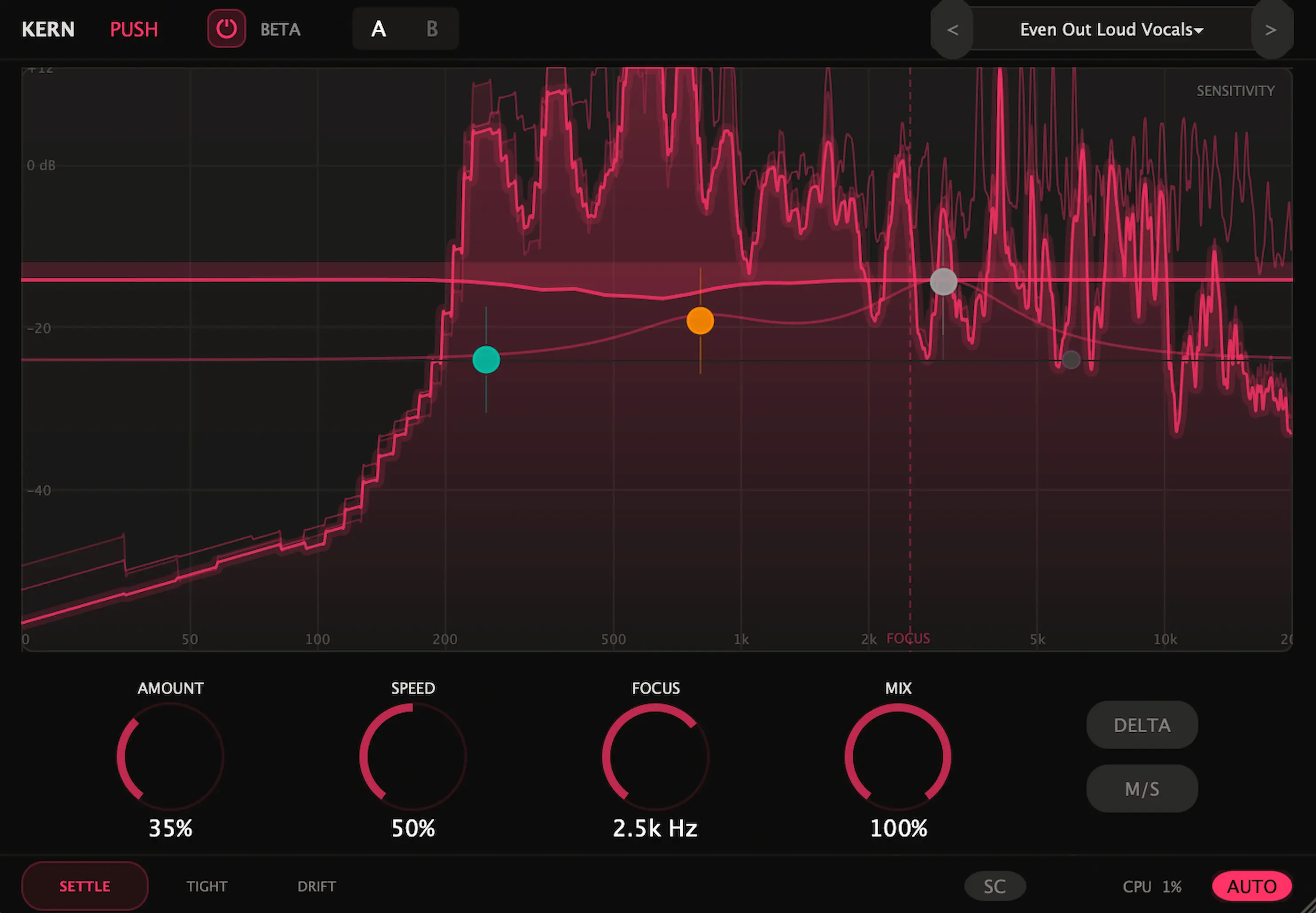
The step before your compressor.
Per-band dynamics your broadband compressor can't reach. SETTLE for bus glue, TIGHT for transients, DRIFT to lift detail. 40 ERB bands, no phase artifacts.
Three ways to compress.
SETTLE
- Cohesion for the mix bus. Gentle per-band gain reduction that settles elements together without you hearing it work. The frequency-aware layer before your regular bus compressor.
TIGHT
- Transient control on drums, bass, and percussion. Fast attack with per-band release that catches stray peaks your broadband compressor would average away.
DRIFT
- Detail recovery. Upward per-band compression that lifts room tone, sustain tails, and high-frequency air without pumping up low-frequency mud. No broadband compressor can do this.
What makes PUSH different.
01 / Three characters, one per workflow
- SETTLE glues the bus, TIGHT holds transients, DRIFT lifts quiet detail. different gain computer, timing, and coloring per character. they sound different, not just look different.
02 / 40 ERB frequency bands
- Dynamics mapped to the same critical bands your ear resolves. not four arbitrary crossover points. 40 perceptually spaced bands following how you actually hear.
03 / Magnitude-only processing
- Gain is applied to magnitude only. Phase stays untouched. No smearing, no comb filtering, no crossover artifacts.
04 / Upward compression per band
- DRIFT lifts ambience, room tone, sustain tails, and high-frequency air without pumping up low-frequency mud. Upward compression per band, not a single broadband lift.
Features
- 40 ERB bands
- 4096-point FFT
- under 3% CPU
- 36 factory presets
- 4 knobs + 2 toggles
- $29 forever
- VST3 / AU
- magnitude-only gain
- M/S processing
CHECK
See where your stereo falls apart.
Real-time correlation across 40 frequency bands. Bass-weighted scoring tells you what will survive a club system, not just a single number.
See what your mix looks like in mono.
CHECK analyzing a stereo mix. The correlation curve shows safe frequencies in green and problem areas dropping into the red zone.
Features
Spectral correlation curve
- See mono compatibility across 40 frequency bands in real time. Not just a single number — a full picture of where your stereo image holds up and where it falls apart.
Bass-weighted score
- The score weighs low frequencies 3x heavier than highs — because that's where mono collapse actually hurts. If your bass drops below 60%, your low end won't survive a club system.
Frequency-focused analysis
- The FOCUS knob lets you zoom into LOW, FULL, or HIGH frequency ranges. isolate your bass mono compatibility or check just the stereo highs.
Instant mono and side monitoring
- MONO button collapses to mono so you hear the damage. SIDE button solos the difference signal — everything that disappears in mono, isolated.
Colour-coded curve and bar chart view
- The correlation curve changes colour as it crosses zone boundaries — mint where you're safe, amber for caution, red for phase cancel. Flip to bar chart mode via the right-click menu to see all 40 ERB bands as discrete coloured rectangles. Spot a single problem frequency at a glance.
Smart education that names the frequency
- Instead of generic warnings, CHECK tells you exactly what's happening: "phase cancel around 80 hz. Often an out-of-phase kick and bass relationship." Three message variants per problem rotate as you iterate, so you learn three common causes per region. Bass is treated as more critical than highs because that's where mono collapse actually hurts.
MacOS
- macOS 10.13+, Intel or Apple Silicon
Windows
- Windows 10+, 64-bit
DAW
- any VST3 / AU compatible host


