


 Log In
Sampleson on Stage54
Sampleson on Stage54, and How We Made our New Collaborative Plugin Together
Model citizens Augusto Filamino and Lucia Tkach use spectral modelling to summon rare instruments to life
Thanks to continuous innovation in the field of virtual instrument development, music producers today can arm their tracks with authentic sounds they could only have ever dreamed of owning previously. Fancy a string section? Check. What about a church organ? Check.
Sampleson, the developers behind our new electric piano plugin Stage54, are the craftspeople working behind the scenes in this exciting space. Their range of virtual instruments covers everything from brushed drum kits to additive synthesizers, but their area of speciality is vintage pianos.

"I’ve been playing piano since I was five years old,” says Augusto. “I play in a band, and I was born with musical instincts. I think I have a certain way of perceiving sound that makes me able to listen to two Yamaha C7 grand pianos, for instance, and know very clearly which one I prefer.”

How did the idea for Stage54, a collaborative plugin between Sampleson and Plugin Boutique, come about?
Lucia: We’ve always had a great relationship with Plugin Boutique, even before we started this project. Around a year ago we got together with Alastair [Partnership/Product Line Manager] from Plugin Boutique and proposed the idea for this instrument. The process of bringing the instrument to life was very much a collaborative effort. We agreed to develop the plugin, and then a year later, including a period of testing, it was ready for release.
Augusto: I had the initial idea for the instrument. I fell in love with a video I saw on YouTube of a guy playing a 54-key electric tine piano, which had a really unique sound. We have a 73-key version already, so we just needed to find and analyse recordings of the instrument to come up with the character of Stage54. We use a kind of spectral analysis for music and sounds, with an algorithm that learns from audio and extracts data.
What is it about the sound of the instrument that makes it unique?
Augusto: The thing I love about this instrument is how it sounds when it’s played at low velocities – the notes sound different each time you play them. It’s more noticeable than when you play with higher velocity because with higher velocities everything is pushed to the limit. Our modelling engine allows you to play a note a million times, and it will constantly vary it – we call that ‘Infinite Round Robins’. Each time you play a note on a real instrument, it will sound different, and I’m really happy that we were able to reproduce that characteristic.
What can you tell us about the type of modelling you do when you’re developing your instruments?
It’s called spectral modelling, which is different to physical modelling. Spectral modelling is based on real recordings of instruments, and with the right analysis, you can extract data that allow you to reproduce the features of the instrument with maths and code. Physical modelling is about reproducing the shape of the parts that are generating the sound. In many ways, an instrument that has been recreated through spectral modelling is closer to the sound of a sampled instrument, but with the benefits of being a smaller size and not static.
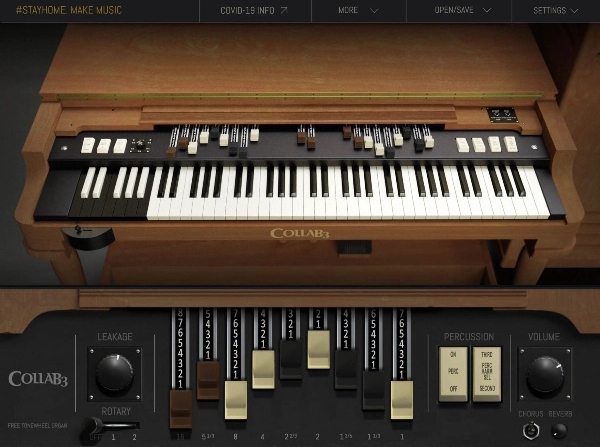
If you start working with an instrument and it’s not in perfect condition, would you try and repair it, or preserve those inconsistencies in the sound?
Our modelling process allows you to capture a range for an individual note. If you have a note that isn’t in perfect condition, you can capture it with those existing parameters and then capture it again with perfect tuning afterwards. Once you’ve mapped the parameters, you can play with them. Let’s say you want to make a gradual pan from note 22 to note 76. You can do a perfect pan, note by note, or you can tweak the first octave in some way. So, in a scenario with an instrument that wasn’t in perfect condition we might repair it to make it sound nice, but also capture ‘broken’ sounds that are playable in the range of notes the plugin would then allow.
In a musical sense, what would Stage54 be useful for?
It’s great for chords or soloing in the high register. The Infinite Round Robins feature gives you the chance to play a solo and record the MIDI, and then the next take will be ever-so-slightly different. That’s how real instruments work – you play the same solo 20 times and you get 20 different solos.
How you use the piano in your productions will depend on how you process the sound. We focused on an extremely simple instrument because we realised that most people have a ton of amp simulators and effects already. So, you can take the raw sound and process it as a rhythm instrument, or make it feel like a lead instrument, with tons of reverb – it’s up to you! The plugin has a few built-in effects, but we spent most of our time trying to get the right raw sound.
The UI changes to reflect the time of day – is that the first time you’ve done that with a plugin?
We actually did that before with Reed106, which was the first instrument we built using our new engine. It basically works off the local time of your computer, and the plugin tracks it and changes the interface accordingly. It doesn’t need to connect to the internet or anything.
We want our instruments to give you as close to the experience of having the real thing as possible. Everyone wants to have loads of classic guitars, or top-of-the-range Yamaha and Steinway pianos, but not everyone can afford them or fit them in their studio. We want our customers to feel like they’re sitting in front of a real instrument.
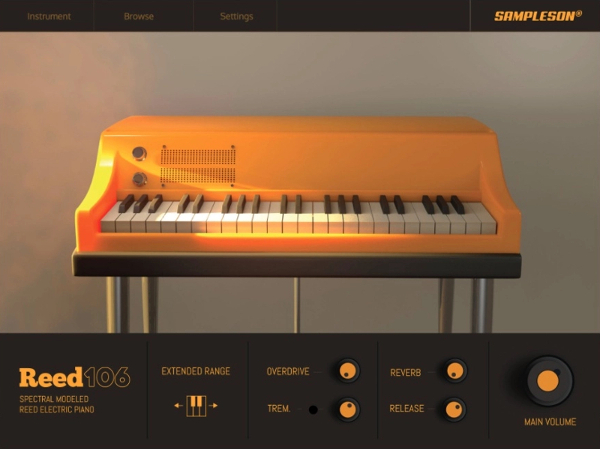
How do you decide what instrument to model, and what are the next steps after you’ve decided on something?
The process is kind of weird. I have a folder on my computer with tons of mad sketches, for example, I was working on an applause generator recently, where you can adjust the number of people in the room, the size of their hands, and the level of their excitement. So, there are a lot of unfinished sketches in the folder, and we prototype some things and only fully develop a few select ideas. The decision to take something forward into development isn’t that professional, it really just comes down to us liking the sound of something we’re working on, and thinking that other people might like it as well.
Which instrument that you’ve modelled has the best story?
There’s a good story behind 1959. We found a patent for an electric piano that never saw the light of day, read a lot about it, and we physically modelled an instrument following the specifications; something that had never existed before. We imagined what the case would look like and came up with our own design. We had a few clues, for example, the size of the harp, which was intended to be vertical and not horizontal. If you look at the UI for the interface you’ll see the vertical harp, similar to an upright piano.
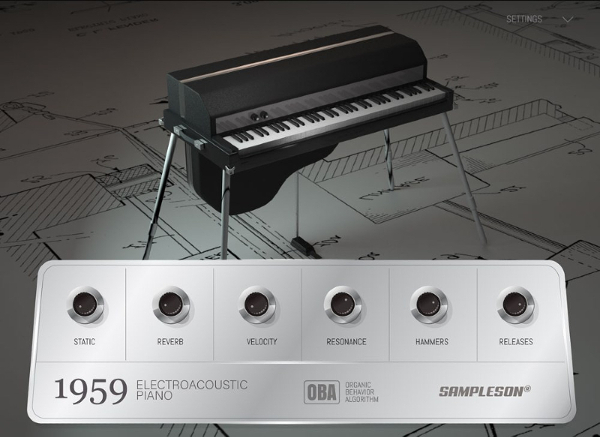
The most important part of the development of the instrument was how it sounded, and the internal mechanism of the instrument is reproduced according to the original patent. Because it was never built, there are no recordings of it, but we predicted how it would sound ourselves. We modelled the piano with one string per note, in comparison to acoustic pianos that have mostly three strings that are hit by a hammer.
What’s next for Sampleson?
As a company we had a year or so with fewer instrument releases than usual, owing to the fact that we were developing our new spectral analysis engine. We put a lot of time and thought into the new engine, and we’re really happy with it. Now that it’s finished, we’re using it a lot, and we want to push forward and release as many instruments as we can!
You can get Stage54 for yourself here, as well as access to a full features list, system requirements and installation instructions. Browse Sampleson’s entire range of inspirational instrument plugins on Plugin Boutique here.

Other articles
ESEA Heritage Month: 5 Artists You Should Know About
Founded in September 2021 by besea.n (Britain's East and South East Asian Network), ESEA Heritage Month celebrates the culture, history, and contributions of East and Southeast Asian communities across the UK. To mark the month, we’ve partnered with ESEA Music, a UK-based, community-led non-profit founded in 2021 to empower ESEA artists and music professionals, to spotlight five incredible independent artists shaping the UK music landscape. Jeremine Chan Malaysian Chinese • Multi-Genre / E
Aaron Suiss Builds Self-Actualization From Diva’s INIT Patch
Presets are a normal part of modern production, and Aaron Suiss is pretty open about using them for some of the biggest layers in his latest release, “Self-Actualization,” which spent a week in the Hype Charts on Beatport. The bass and pad began with Plug Hugger presets inside u-he Diva. But the star of the show was the arpeggiator, which he created from INIT after the options he auditioned just didn’t bring the emotional depth and power the record needed. Created with Enzo Vood and released
Synth Month Sale: The Best Deals on Synth VSTs & Bundles
It’s September, and that only means one thing for all you producers out there – it’s Plugin Boutique’s Synth Month, the ultimate synth plugins sale! Across the month, you can buy synthesizers at massive discounts. Expect big savings on the best software synths, from characterful vintage synth emulations all the way through to cutting-edge modern sound machines. Not only that, but you’ll be able to pick up some deliciously discounted synth bundles that can’t be missed. To celebrate, we
Free VST Plugins You Should Actually Get
[Article Last updated: 12 September 2026] – There are a lot of free plugins out there, and you can sometimes feel overwhelmed by the paradox of choice. Thankfully, we've done the hard work, so you don't have to. Here’s a carefully curated list of the best free plugins that pretty much any music producer can benefit from. We even update this list approximately weekly to keep you informed of the new free plugins arriving on the scene. We’ve been especially considerate of plugins with a wi


