


 Log In
The 11 Types of Reverb – and When to Use Them
Discover the different reverb effects that producers and guitarists use, understand how they work and what they’re good for with this guide
Reverb might be the first effect that many producers come across, with the echoing and god-like sounds being impressive to someone who’s never had this level of sonic control. Perhaps the second lesson a producer will learn with reverb is how to not go too far – avoiding drenching a signal in the stuff.
There’s a lot more to learn about reverb after the very basics. There are many types of reverb, and when to use each one isn’t necessarily clear from its sound alone. While you can ‘get away with’ using a spring reverb on a vocal or a chamber reverb on drums, you’re more likely to find yourself getting stuck with your sound and not knowing quite why.
By learning what types of reverb are useful for what applications, you’ll become a better producer, and that’s exactly what we’ll cover in this article.
In This Article
We’re going to be taking a deep dive into all things reverb related. Journey with us through an exploration of all of the different types of reverbs with a few worthy mentions of significant members of each category. Then, finally, we’ll be sharing our personally-favoured contender for each type.
So, without further ado, let’s step directly into the echoing hall of reverb fame.
Algorithmic vs Convolution Reverb
These two types are a dichotomy in digital reverbs – IE plugins – and use different approaches to create their reverb effects.
What is convolution reverb?
It’s a type of reverb that loads an impulse response file – literally an audio file with a recording of a loud impulse sound in a space – in order to recreate the sound of that space and apply it to other sounds as a reverb signal.
Examples of Convolution Reverb plugins include Waves IR-1, McDSP Revolver, and AudioThing Fog Convolver. They are able to simulate almost any reverb signal or environment if you have the right impulse response file – most convolution plugins come with many of them, and they’re also downloadable from around the web.
What is algorithmic reverb?
It’s a type of reverb that’s been built by an audio software developer to produce a reverb signal using operations like delay lines, all-pass filters and more. In a way, ‘algorithmic’ is a catch-all term for a reverb that doesn’t use convolution, instead building its ‘virtual’ reverb signal out of audio processing components.
Algorithmic reverbs include plugins like UJAM Reverb 2, Baby Audio Crystalline and Acon Digital Verberate 2. You could consider digital emulations of analogue reverb units to be algorithmic, but for our purposes here, we’re classifying them as two different things.
An algorithmic reverb plugin has more scope to do things in an innovative way, and may feature more ‘mod cons’ like sound reversal, longer delay lines and effects.
What’s the difference between algorithmic and convolution reverb?
Convolution reverb uses impulse response files to generate a reverb signal using convolution – a mathematical operation that can apply recorded signal properties to input audio. In an algorithmic reverb plugin, its properties are built ‘from the ground up’ by its developer to simulate a reverb signal using individual audio processors. In many ways, ‘algorithmic’ means ‘not convolution’, but for the purposes of this article, we’ve got more categories to introduce.
Analogue vs Digital Reverb
Digital reverbs generally include the two reverbs mentioned above – algorithmic and convolution. Analogue reverb predates digital reverbs, from the days when studio engineers would record sounds in echo chambers or route a signal from a mixing desk out to a plate reverb unit.
Analogue reverbs have also been recreated in digital format, which makes our explanation here a little more confusing. When you consider a plugin like Soundtoys SuperPlate, Pulsar Primavera and Abbey Road Chambers, which are digital recreations of analogue reverbs, with some added benefits, it’s not easy to keep track of how to categorise everything.
Room Reverbs
Perhaps the most standard type of reverb is the humble ‘room’. We spend almost all of our time in rooms, so we’re overwhelmingly used to their sound, and practically all music is recorded in a studio room – a live room that’s built to sound great. For that reason, practically any sound will work when piped through a room reverb… except perhaps a choir?.
For a simple, understated sound that’s got a sense of space but doesn’t completely soak you in echoes, finding the right room is a great option. Plugins for getting that room sound include Denise Audio Perfect Room 2, a specific studio room model such as IK Multimedia CSR Room Reverb, and many reverb plugins that contain a list of room presets, such as FabFilter Pro-R 2.
Hall Reverb
A room may be very natural to us, and it may be an ideal for studio-recorded music, but what’s the ideal for a live show or a classical music venue? Well, then you’re looking for a hall reverb. A hall mimics the larger environment of a concert hall, live music venue, or at its smallest, your local community centre.
A hall can be a great environment for a vocal that you want to make more impressive. While drums may suffer from overkill in a hall environment (although that’s not to guarantee they won’t work), try a hall reverb on guitar or keys to get that grand sound.
If you’re looking for a hall reverb sound, most algorithmic reverb plugins will have a hall category in their presets. FabFilter Pro-R 2 and iZotope Neoverb would be good candidates, for example, and you’ve probably got a few good presets available from your existing reverb plugins.
Plate Reverb
One early method of creating artificial reverb was to use a metal plate, held within a frame in a box. The plate would be driven by the input audio signal, and its resonating, vibrating shimmering output would be recorded and used as the output reverb signal.
A plate reverb is a staple of 60s and 70s recording and mixing technology, and it sounds great on vocals, works well on drums, and can bring a rich, not-quite-realistic vibe to practically any part of a mix.
Great plate reverb plugins include Fuse Audio Labs VREV-140, Soundtoys SuperPlate and Universal Audio Pure Plate Reverb.
Spring Reverb
One of the earliest artificial reverbs was the spring. By sending an audio signal through a spring – yeah, a literal metal spring – the sound would be delayed and would literally bounce back and forth up and down the coil, leading to a fairly reasonable reverb sound. Not only that, but springs were possible to fit into guitar amps, making the effect immediately accessible for many guitarists. Surf guitar classics like Miserlou by Dick Dale and Pipeline by The Chantays are drenched in spring reverb.
So what plugins can you get hold of to secure the sound of spring reverb? Your first stop should be Pulsar Primavera, which is stuffed with six springs from different eras. Also try out u-he Twangstrom and Fuse Audio Labs VREV-63.
Digital Studio Reverb
As studio technology developed, digital technology started to become a viable way to process sound, and reverb was the obvious effect to push that particular envelope – since the time delay inherent in a digital system wouldn’t be a problem for an echoing effect.
Some early digital reverbs became absolute classics, with units like the Lexicon (emulated in ReLab LX480 Essentials) and units like the RMX (emulated in Wave Alchemy Glow) becoming studio favourites. Another plugin to check out is Cherry Audio’s Galactic Reverb, which is a spin on a more generalised idea of digital studio reverbs.
Chamber Reverb
Another reverb type from the early days of recording, a chamber was literally that – a chamber with an almighty echo, where the signal could be played (or recorded within) while the sound of the chamber itself would be picked up by microphones and piped back to the studio control room.
What sounds good in a chamber? Vocals of all types, including backing vocals. You may not get the best experience with other instruments in chambers, though with the right settings, the stars can align.
Some great choices for chamber reverbs are Softube’s Atlantis Dual Chambers, UA’s Hitsville Reverb Chambers, and Waves Abbey Road Chambers.
Extreme Reverb
Not just ignoring the lines between reverb categories but completely laughing at them, these reverbs are all about giving you an extreme sound. While a chamber or large hall reverb may be the largest ‘real’ reverbs you can attain, something like Eventide Blackhole intentionally takes you further, with huge, out-of-this-world effects.
Other extreme and unusual reverbs include Aberrant DSP Lair, MNTRA Instruments’ Borealis, and Cableguys ReverbShaper.
Our Recommendations for Reverb Plugins of Each Type
Our Favourite Reverb Plugin Overall
FabFilter Pro-R 2 is our current pick for most highly rated reverb plugin. Truly a reverb for all seasons, Pro-R has you covered with its choice of algorithms, its EQ, and its EQ–but-not-an-EQ blue curve for setting the decay time across the frequency spectrum.
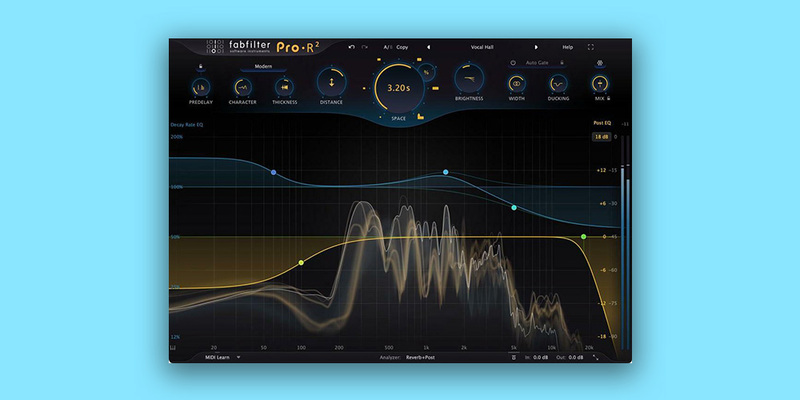
Pro-R also allows you to load impulse responses to perform convolution, to use vintage and plate reverb types, and does it all using controls that have real resemblance to the actual word we live in. All of this makes Pro-R 2 the best reverb plugin overall, although there’s strong competition.
Our Favourite Free Reverb Plugin
TAL-Reverb 2 comes in hot for our best free reverb plugin spot. It’s a retro verb with a vintage sound, providing you with all the necessary processing parameters you’ll need from a reverb plugin.
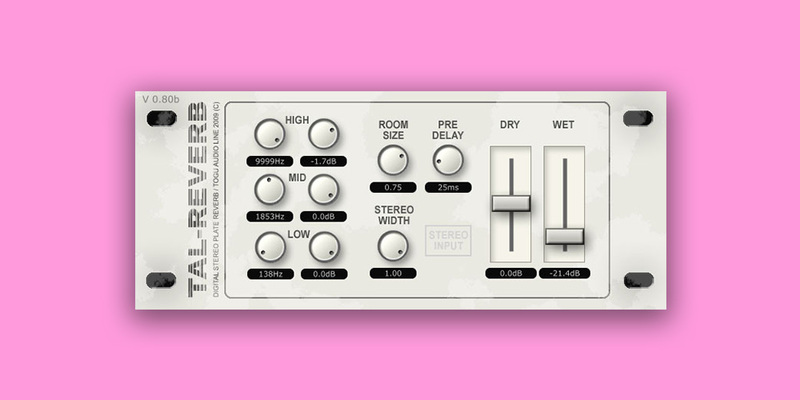
Sure, it’s not the greatest reverb plugin ever made, and the GUI might not also be the most attractive, but for the total cost of…. nothing, you can sure bring some great digital reverberation to your DAW in no time or effort at all.
Our Favourite Room Reverb Plugin
If you’re searching for the best room reverb plugin, look no further. Denise Audio Perfect Room 2 is certainly a worthwhile candidate, and fits the bill as our favourite on this list. With crystal clear reverberation and surgical-precision controls to fine tune your effect, Perfect Room 2 certainly lives up to its name as a pretty-much-perfect reverb plugin.
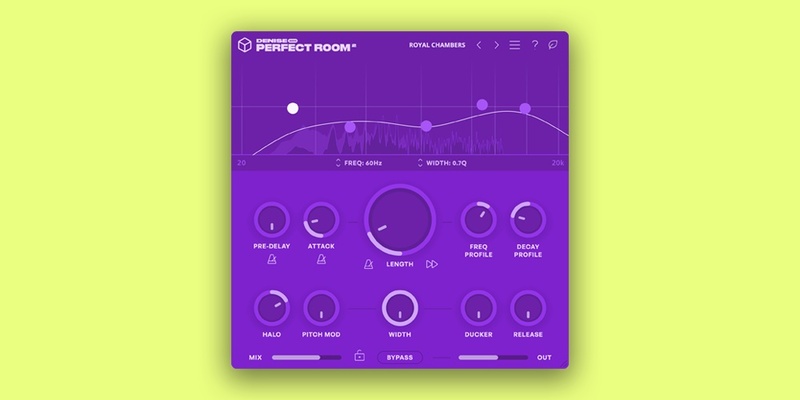
Featuring a unique Dynamic Room Simulation technology engine, Perfect Room 2 also brings something new and interesting to your reverb FX palette, certainly delivering bang for your buck. This means you can rest assured knowing you’re not just investing in another typical, generic reverb plugin.
Our Favourite Chamber Reverb Plugin
When it comes to the best chamber reverb plugin, it’s really a no-contest decision. Softube’s Atlantis Dual Chambers takes the cake with quite a hefty precise point–however, with very good reason. The plugin is built from the intricate and detailed room reflections of the legendary Atlantis Studios in Sweden–the home of ABBA!
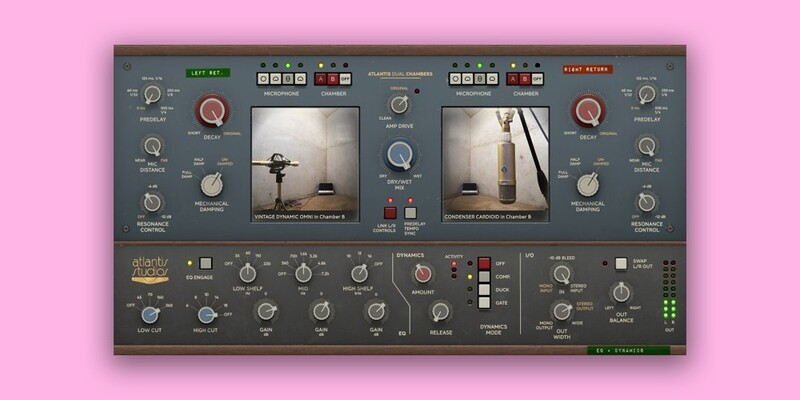
Created, captured, licensed and published in official collaboration with the famed Stockholm Atlantis studios themselves, you can now take the prestigious dual chambers into your own hands. And, with different microphone options, as well as Damping, Resonance, Dynamics and EQ controls, you’ll have plenty to sink your teeth into for a long time coming.
Our Favourite Hall Reverb Plugin
There’s no one plugin that’s specially built for halls, but we think that iZotope Neoverb is well worth a look for your needs in this category. It definitely does feature some impressive hall presets, and, coming jam-packed with such a wide array of complex, yet easy-to-navigate capabilities, Neoverb is worth adding to your FX library anyhow.
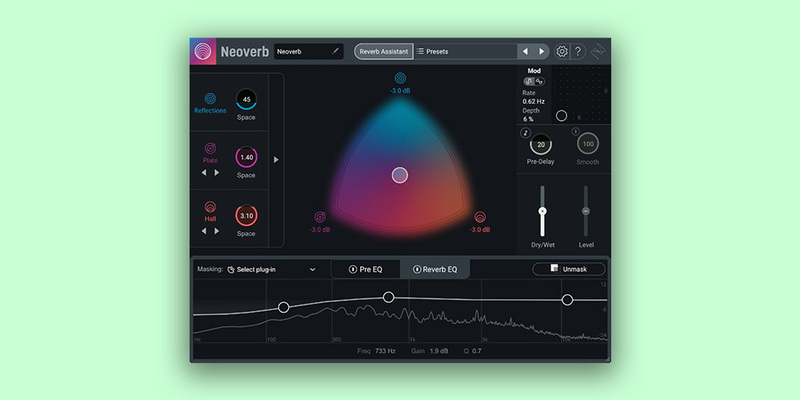
Most of the controls are implemented with minimalistic X/Y matrices and knob controls, giving you peace of mind to engage with, even if you don’t fully understand all the intricate details. With all things considered, and without a clear hall reverb competitor, we think that iZotope’s Neoverb deserves the top spot as the best hall reverb plugin.
Our Favourite Spring Reverb Plugin
Pulsar Primavera is a luscious and elegant spring reverb, featuring a slick design. This nimble little reverb plugin is vintage in both its sonic and visual characteristics and it boasts a 6-in-1 total reverb devices from throughout the ages, giving you a hi-fi or lo-fi potential, depending on the needs of your situation.
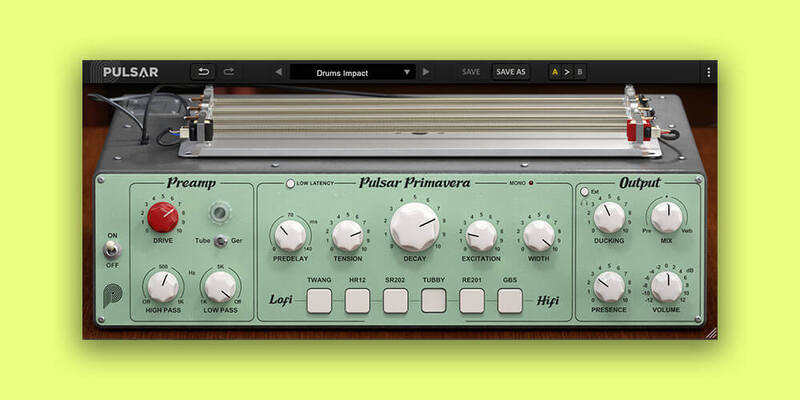
It won’t take you long to become well acquainted with Primavera, and with its simplistic, yet efficient design, you won’t be overwhelmed with complexity – as is often the case with many competitors. This signature classic is realistic and versatile, making it the best spring reverb plugin on this list.
Our Favourite Plate Reverb Plugin
We can’t discuss plate reverbs without mentioning Soundtoys SuperPlate. It’s yet another all-so-effective reverb plugin. We can’t stress it enough, a good-sounding plugin is important, but it’s the well-implemented design and not-rough-around-the-edges that can really make or break a plugin’s potential to meet the requirements necessary to fill the shoes of the top spot. SuperPlate meets the criteria.
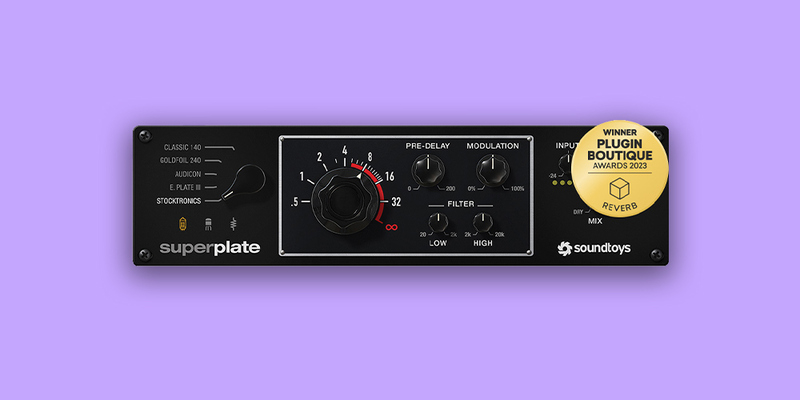
Because of that, we place it as the best plate reverb plugin on the list. With emulated plate circuit types to choose from, and an internal EQ panel, this plate reverb will be delivering the shimmering edge to your tracks in no time at all.
Our Favourite Algorithmic Reverb Plugin
As a purely algorithmic effect, we're mentioning this one again - FabFilter Pro-R 2 does what it sets out to do, effectively, with very minimal downsides.
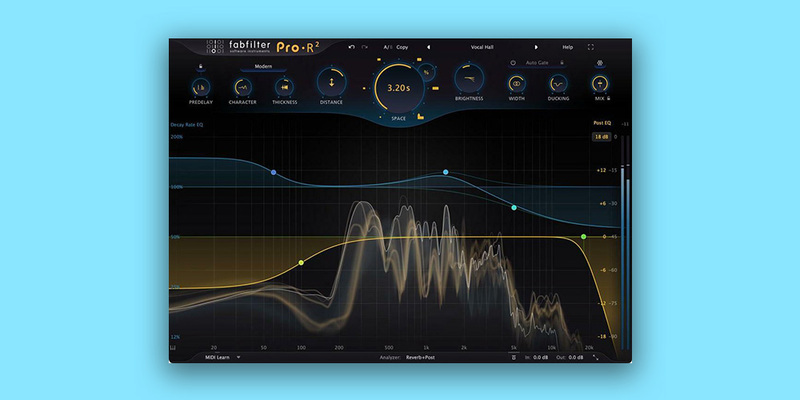
With an intuitive interface, an abundance of presets and easy-to-navigate control panels, it’s a force to be reckoned with. This alone makes it a probable favourite amongst many audio engineers, both newbies and professionals alike. In other words, It’s caked in “go-to-reverb-plugin” potential! This makes it easily the best algorithmic reverb plugin available.
Our Favourite Convolution Reverb Plugin
When it comes to the best convolution reverb plugin, AudioThing Fog Convolver is absolutely the bee’s knees. The interface can be a little bit more daunting when first booted up, however, in due time, you will soon familiarise yourself with the excess of customisable parameters, carefully-curated presets and limitless convolution reverb potential.
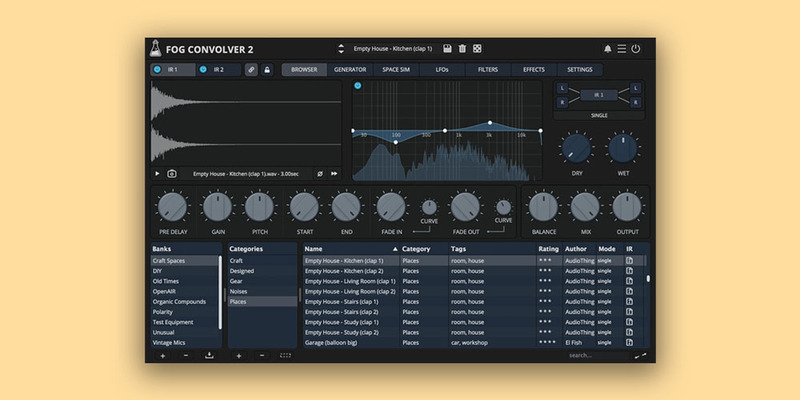
The second version of Fog Convolver has been released with a fresh design from scratch and the newly-added capability to load up two separate impulse responses, with the potion to have separate or conjoined controls for both. There are also five different routing modes for each and an abundance of many, many more intricate controls. This reverb plugin really doesn’t mess about, and if you’d like to explore its full capabilities, check out its dedicated Plugin Boutique store page.
Reverb Plugins FAQ
What are the five main types of reverb?
The five main types of reverb are: plate, spring, hall, room and chamber. Each of these types of reverb are built with separate design and technology, with digital counterparts emulating the unique sonic characteristics of each.
The five types have become preferably accustomed to different tasks in the studio environment. That’s to say, each type of reverb might be more well-suited toward a different task or instrument type.
What is room size when talking about reverb?
Reverb refers to the different size in the simulated room of a reverb effect. Usually, you can choose to opt for a smaller or larger room size, depending on the circumstance. This will influence things such as the decay time, room character and early reflections.
Examples of two very different room types would be a cathedral hall, compared to a bedroom studio. WIth digital reverb processing, we can simulate these two juxtaposed room types, as well as many, many shapes and sizes beyond and in between.
What are the most important controls to look out for in reverb plugins?
Perhaps the most important control of a reverb plugin is its dry/wet mix control, as this will influence just how intensely applied the reverberation effect is. However, on its own, this does very little to alter the characteristics of the reverb.
To truly shape the reverb’s character, you’ll need to rely on pre-delay, decay time, room size, damping and diffusion controls.
What is the difference between algorithmic reverb and Convolution reverb?
The difference between the two comes down to how the space of the reverb effect is manifested in the digital realm. An algorithmic reverb plugin relies on computer, mathematical algorithms to purely simulate a real-world space and deliver its reverberation properties to your desired track.
A convolution reverb uses actual real-world impulse response, recorded from actual places, to capture reverb properties and convert them to digital counterparts in your computer. With convolution, you can record tha actual characteristics of your favourite real-world environment and then apply them to any digital sound within your DAW.
Other articles
The Best Music Software Deals This Week [Live List]
As the music production landscape evolves week by week, so does the opportunity to save on powerful creative tools. New plugin releases, flash sales on VSTs and limited-time deals on music software can appear from any angle, making it harder than ever to keep track of what’s worth your attention. Whether you're looking for the latest bundles on offer, or even deals on exciting virtual instruments, it's as important as ever to stay up to date on what we have to offer. That’s where our live g
ESEA Heritage Month: 5 Artists You Should Know About
Founded in September 2021 by besea.n (Britain's East and South East Asian Network), ESEA Heritage Month celebrates the culture, history, and contributions of East and Southeast Asian communities across the UK. To mark the month, we’ve partnered with ESEA Music, a UK-based, community-led non-profit founded in 2021 to empower ESEA artists and music professionals, to spotlight five incredible independent artists shaping the UK music landscape. Jeremine Chan Malaysian Chinese • Multi-Genre / E
Aaron Suiss Builds Self-Actualization From Diva’s INIT Patch
Presets are a normal part of modern production, and Aaron Suiss is pretty open about using them for some of the biggest layers in his latest release, “Self-Actualization,” which spent a week in the Hype Charts on Beatport. The bass and pad began with Plug Hugger presets inside u-he Diva. But the star of the show was the arpeggiator, which he created from INIT after the options he auditioned just didn’t bring the emotional depth and power the record needed. Created with Enzo Vood and released
Synth Month Sale: The Best Deals on Synth VSTs & Bundles
It’s September, and that only means one thing for all you producers out there – it’s Plugin Boutique’s Synth Month, the ultimate synth plugins sale! Across the month, you can buy synthesizers at massive discounts. Expect big savings on the best software synths, from characterful vintage synth emulations all the way through to cutting-edge modern sound machines. Not only that, but you’ll be able to pick up some deliciously discounted synth bundles that can’t be missed. To celebrate, we


